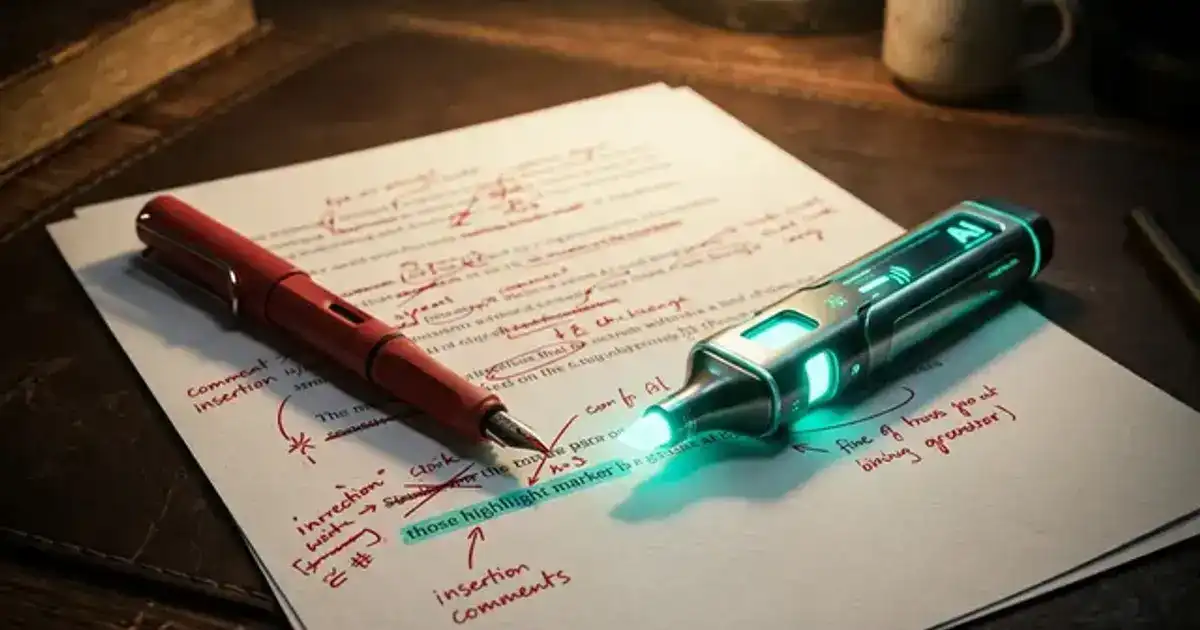
Editing your own writing is hard because you cannot see your own blind spots. You read what you meant to say, not what you actually wrote. A writing coach catches what you miss - and ChatGPT can play that role surprisingly well.
The key is to use AI to diagnose problems, not to prescribe solutions. You want it to say “this paragraph is unclear” so you can rewrite it, not “here is a better version.”
The AI Editing Workflow
The Editing Prompt
“Review this paper as an academic writing coach. Do not rewrite anything. Instead, identify: 1) Weak arguments that need more evidence, 2) Paragraphs that are unclear or poorly structured, 3) Transitions that are abrupt, 4) Places where my thesis is weakened. For each issue, explain what the problem is - but let me decide how to fix it.”
What AI Is Good (and Bad) at Catching
✅ Good at Catching
- Logical inconsistencies in arguments
- Unclear or run-on sentences
- Missing transitions between paragraphs
- Unsupported claims
- Basic grammar and spelling
⚠️ Not Great at
- Evaluating the depth of your analysis
- Understanding your professor's specific preferences
- Catching tone mismatches
- Knowing if your evidence is relevant to your field
Critical rule
Never paste AI's feedback directly into your paper. Read the feedback, understand it, then rewrite the problematic sections yourself. The feedback improves your awareness. Your hands do the rewriting.
For grammar-specific editing, our Simplifier Specialist prompt can help simplify complex sentences without altering your voice.